First-Time Landlord Checklist: Everything You Need Before Handing Over the Keys

Key Takeaways
- Before handing over keys, you need landlord insurance, a compliant lease, a completed move-in inspection report, and a separate bank account for rental income.
- Photograph every room on move-in day — dated photos are your protection against security deposit disputes.
- Know your state's landlord-tenant laws before your first tenancy, not after your first dispute.
- Set up a maintenance request process and a rent collection method before the tenant moves in, not after.
The gap between owning a rental property and operating it professionally is where first-time landlords lose money. Most of the costly mistakes — improper lease clauses, undocumented move-in conditions, missing maintenance records, fair housing violations — are not the result of bad intentions. They are the result of not knowing what systems need to be in place before the first tenant ever walks through the door.
Use this checklist before your first tenancy begins. Each section represents a category of risk that professional landlords manage systematically and that first-time landlords often discover only after something has gone wrong.
Legal and regulatory compliance
Confirm that your property is zoned for the type of rental use you intend. Single-family residential zoning in many municipalities prohibits short-term rentals. Multi-family conversions may require permits or certificate of occupancy updates.
Research your state and local landlord-tenant laws. Requirements around security deposits, required lease disclosures, habitability standards, and notice periods for entry or lease termination vary significantly by state and sometimes by city. The laws that apply to you are not the ones you read about in a national article — they are the specific statutes in your jurisdiction.
Register your rental property with local authorities if required. Many cities require landlords to register rental units, pass inspections, or obtain a rental licence. Operating without required registrations can void your lease and expose you to fines.
Obtain landlord liability insurance and verify that it is active before handing over keys. Your standard homeowner's policy almost certainly does not cover a tenant-occupied property. You need a landlord policy — also called dwelling fire or rental property insurance — and the coverage limits should reflect the replacement value of the building and your liability exposure.
The lease agreement
Use a lease agreement that complies with the laws of your state. A generic template found on a free website may lack required disclosures — lead paint disclosure, radon disclosure, bed bug disclosure, mould disclosure — that your state mandates for residential leases. Leases missing required disclosures may be unenforceable or expose you to penalties.
Your lease should specify the rent amount, due date, late fees (subject to your state's limits), security deposit amount, occupant names, pet policy, smoking policy, maintenance responsibilities, and grounds for eviction. Review every clause against your state's landlord-tenant statute before using it.
Complete Property Management Bundle
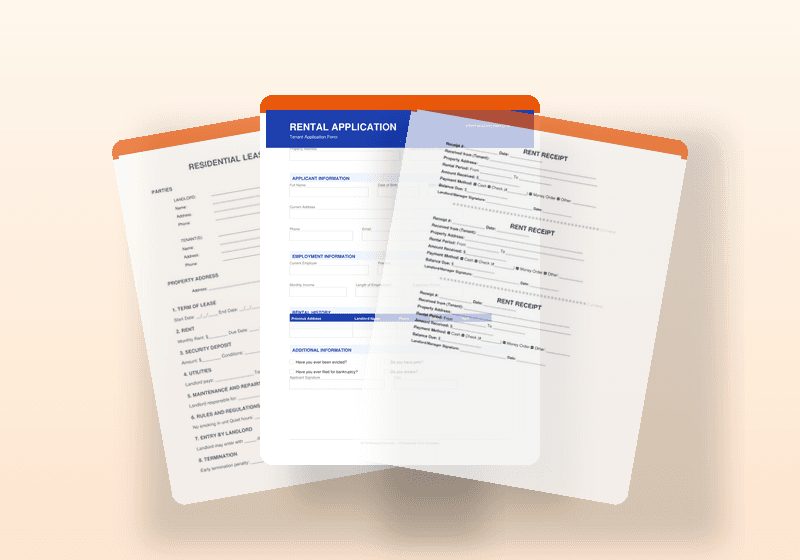
The template this guide walks through — ready to customize with your details in ZIP Bundle — 34 PDFs format.
Property readiness
Document the condition of every room before the tenant moves in. Walk through the property with a camera and take dated photographs of every surface, appliance, fixture, and any existing damage. This move-in documentation is your evidence if the tenant causes damage and disputes the security deposit deduction at move-out.
Complete a written move-in inspection report with the tenant present. Both parties should sign it. The signed report, combined with your dated photographs, creates an agreed record of the property's condition at the start of the tenancy.
Verify all safety equipment is installed and operational: smoke detectors on every level and in every bedroom, carbon monoxide detectors as required by your state, fire extinguisher accessible in the kitchen, and all windows and exterior doors with functioning locks.
Financial systems
Open a separate bank account for rental income. Mixing rental income with personal finances creates accounting problems, makes tax filing more complex, and is difficult to unwind if you need to demonstrate rental income or expenses.
Establish how you will collect rent and communicate this clearly to the tenant before they move in. Specify in the lease whether rent is payable by cheque, bank transfer, or online payment, and where late fees begin to accrue.
Understand how your rental income will be taxed. Rental income is taxable at your marginal rate, but expenses including mortgage interest, insurance, repairs, depreciation, and management fees are deductible. Track every expense from day one — receipts for every repair, every supply purchase, every professional fee. A record kept from the start is infinitely easier than trying to reconstruct expenses at tax time.
Operational processes
Have a maintenance request process in place before the tenant moves in. Tell them in writing how to submit maintenance requests, what your expected response time is, and what constitutes an emergency requiring immediate contact. Written maintenance records are also evidence that you are meeting your habitability obligations.
Know your legal obligations for entry notice. Most states require 24–48 hours advance written notice before a landlord can enter a tenant's unit for non-emergency purposes. Entering without proper notice, regardless of reason, is a lease violation in most jurisdictions and can expose you to claims for damages.
Being a landlord is a business. The landlords who run profitable, low-stress rental operations are almost always the ones who put proper systems in place from the beginning — not the ones who fix problems as they arise.
Frequently Asked Questions
What does a first-time landlord need to get started?
A first-time landlord needs: landlord insurance (not a standard homeowner policy), a legally compliant lease for their state, a rental application to screen tenants, a move-in inspection checklist, a separate bank account for rental income, and basic knowledge of their state's landlord-tenant laws governing deposits, entry notice, and the eviction process.
How do I screen tenants as a first-time landlord?
Use a written rental application to collect employment history, income documentation, rental history references, and signed consent for a credit and background check. Verify income against documentation — pay stubs or bank statements. Call previous landlords, not just the current one. Apply the same criteria consistently to every applicant.
What insurance does a landlord need?
A standard homeowner's insurance policy does not cover a tenant-occupied property. You need a landlord insurance policy (also called dwelling fire insurance or rental property insurance) that covers the building structure, your liability as a property owner, and potentially lost rental income. Require your tenant to carry renter's insurance separately.
What are the most common first-time landlord mistakes?
The most expensive first-time landlord mistakes are: not documenting the move-in condition with photographs, using a generic lease that is missing state-required disclosures, failing to verify tenant income against documentation, not knowing state rules on security deposit limits and return timelines, and managing everything verbally rather than in writing.
Complete Property Management Bundle
Professionally designed and formatted. Available in ZIP Bundle — 34 PDFs format. 30-day money-back guarantee.
One-time purchase — use forever.
Related Guides
What Landlords Need in a Lease Agreement (Beyond the Basics)
Read guideLandlord & Property ManagementRental Application Form: What Landlords Should Include to Screen Tenants Properly
Read guideLandlord & Property ManagementHow to Document a Move-Out Inspection to Protect Your Security Deposit
Read guide
Founder, PrintReadyForms · 25 years writing technical documents, contracts, scopes of work, and procedures
Published
All guides on PrintReadyForms are written to help business owners, landlords, contractors, and HR professionals use professional documents effectively. This content is for informational purposes only and does not constitute legal or financial advice. Consult a qualified professional for advice specific to your situation.