Contractor Estimate vs. Invoice: What's the Difference and When to Use Each

Key Takeaways
- An estimate is a pre-work document that prices the job. An invoice is a post-work document that requests payment.
- Estimates should include scope, itemised pricing, validity period, and payment terms before work begins.
- A signed estimate functions as a contract in most jurisdictions and protects you from scope disputes.
- Converting your accepted estimate directly into an invoice reduces billing errors and saves time.
Contractors lose jobs, underprice work, and create client disputes more often than they realize — and the root cause is almost always poor documentation in the estimate or invoice stage. The difference between a contractor who builds a sustainable, profitable business and one who constantly chases payments and fights scope creep usually comes down to how they document work before, during, and after the job.
A contractor estimate and a contractor invoice are fundamentally different documents with different purposes. Using the wrong one at the wrong time — or using a vague version of either — costs you money. Here is a complete breakdown of both documents, when to use them, and exactly what they need to contain to protect your business.
What is a contractor estimate?
A contractor estimate is a pre-work document that communicates the anticipated cost of completing a project. It is a proposal — not a commitment to a fixed price in most cases (though this depends on how it is written). The estimate is what you present to a client when they ask, "How much will this cost?"
A properly written estimate should include:
- Scope of work — a specific, written description of exactly what work will be performed and what will not be included
- Materials list — what materials are included in the estimate price, and whether prices are based on current quotes or estimated costs subject to change
- Labor breakdown — hours estimated by trade or task, with labor rate
- Timeline — estimated start date, duration, and completion date
- Price breakdown — line-item costs for labor, materials, subcontractors, and overhead
- Exclusions — an explicit list of what is not included (permits, site conditions, unforeseen structural issues, disposal, etc.)
- Validity period — how long this estimate is valid (typically 30 days, because material costs fluctuate)
- Payment terms — your deposit requirement, progress payment schedule, and final payment terms
- Client signature line — when signed, the estimate becomes an authorization to proceed
What is a contractor invoice?
A contractor invoice is a request for payment for work that has been completed or is being billed on a progress basis. Where the estimate is forward-looking (what will this cost?), the invoice is backward-looking (here is what was done and what is owed).
A contractor invoice should include:
- Invoice number — unique sequential number for your records and the client's accounts payable
- Reference to the original estimate or contract — "Per estimate dated [date] / Contract #[number]"
- Description of completed work — specific to the billing period or project phase
- Itemized labor and materials — what was used and at what cost
- Progress billing tracking — for larger projects: original contract amount, total billed to date, this billing, amount remaining
- Amount due and payment due date
- Payment instructions — exactly how to pay and where to send payment
- Retainage terms — for commercial projects that withhold a percentage until completion
The key differences between estimates and invoices
Understanding the difference protects you legally and financially:
- Timing: Estimate is before work begins. Invoice is after work is completed or at billing milestones during work.
- Purpose: Estimate communicates what you plan to charge. Invoice records what you are charging for work delivered.
- Legal standing: A signed estimate is a contract for the work described. An invoice is a demand for payment.
- Accuracy: Estimates are projections and may include contingencies. Invoices are records of actual costs and should match or be explainable against the estimate.
- Change orders: If actual work exceeds the estimate, a change order bridges the gap before additional work is done — not after. Never do work outside the estimate scope without a signed change order.
Why vague estimates kill your margin
The single biggest mistake contractors make is writing estimates in broad strokes: "Demo and replace bathroom floor — $4,500." That sentence is a legal and financial liability. When the client sees the invoice and it does not match their mental picture of what was included, you have a dispute. When the job runs over budget because you underestimated labor, you have an unprofitable project. When they want something "extra" that you thought was obviously included, you have a relationship problem.
A detailed estimate protects you by establishing in writing exactly what $4,500 covers. "Remove existing vinyl tile (approx. 120 sq ft) — $180. Subfloor repair and leveling (up to 2 sheets plywood, additional sheets at $85 each) — $340. Install client-supplied tile (labor only) — $1,800. Grout and seal — $420. Removal and disposal of debris — $280. Materials (thinset, grout, backer board) — $380." Now both parties understand what the number includes. When the client asks "can you also paint the baseboard?" the answer is "that is outside the scope of this estimate — here is what it would add."
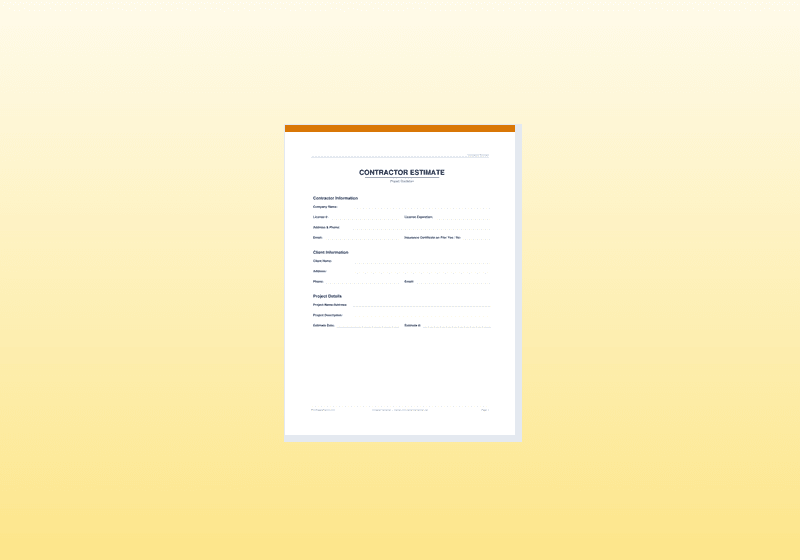
Contractor Estimate & Quote Pack
The template this guide walks through — ready to customize with your details in PDF, ZIP Bundle formats.
Markup vs. margin: the math contractors get wrong
Many contractors price jobs by adding a markup to their costs. The problem is that markup and margin are calculated differently, and confusing them consistently underprices work.
If your materials cost $1,000 and you add 25% markup, you charge $1,250. Your gross profit is $250, which is 20% of the selling price — not 25%. To achieve a 25% gross margin, you need to divide your cost by 0.75: $1,000 ÷ 0.75 = $1,333.
For contractors targeting a 40% gross margin on materials: divide cost by 0.60. For 30% margin: divide by 0.70. Build this into your estimate template so the math is automatic and you never accidentally undercharge.
What to include in your terms and conditions section
Every estimate should have a terms and conditions section that covers:
- Payment schedule — deposit amount (typically 25–50% upfront), progress payments, and final payment due date
- Late payment terms — interest rate or flat fee applied to overdue balances
- Change order process — all scope changes require a signed written change order before additional work proceeds
- Site conditions clause — unforeseen conditions (hidden rot, asbestos, structural issues) may require additional cost and will be documented before work proceeds
- Warranty terms — what is covered, for how long, and what voids the warranty
- Dispute resolution — how disputes will be handled (mediation, jurisdiction for any legal proceedings)
- Permit responsibility — who is responsible for obtaining and paying for permits
- Subcontractor notification — if you use subcontractors, disclose this in your terms
Progress billing: how to invoice on larger projects
On projects larger than a few thousand dollars, invoicing in one lump sum at the end creates unnecessary cash flow risk. Progress billing — invoicing at defined milestones or percentage-of-completion points — protects you by ensuring you have cash to pay for materials and labor throughout the job.
Common progress billing structures for residential contractors:
- 30% deposit before work begins
- 30% at rough completion (framing, electrical rough-in, plumbing rough-in, etc.)
- 30% at substantial completion
- 10% retainage held until punch list is complete and client signs off
Each progress invoice should reference the original estimate, the total contract value, the amount billed in previous invoices, and the amount due for this billing. The client should always know exactly where they stand against the total project cost.
Lien rights: why your documentation matters beyond getting paid
Contractors who are not paid have the right to file a mechanic's lien against the property in most US states. But lien rights have strict procedural requirements — preliminary notices, specific timeframes, and exact documentation. Your estimate and invoice documentation is central to a successful lien claim.
The estimate or contract establishes the amount owed. Invoices establish what was billed and when. Change orders document authorized additional work. Daily logs document progress and materials delivered. If you ever need to file a lien, this paper trail is what supports your claim and withstands a title company's scrutiny.
Even if you never need to file a lien, the documentation that would support one — clean estimates, signed change orders, properly dated invoices — is the same documentation that makes you a professional contractor clients trust with significant projects.
Building a system: what you need beyond the estimate and invoice
A complete contractor document system includes more than just an estimate and an invoice. To run a professional contracting operation, you also need:
- Change order forms — for any scope changes, priced and signed before work proceeds
- Daily construction logs — documenting crew on site, work completed, materials delivered, and any issues
- Lien waiver templates — conditional and unconditional waivers for progress and final payments
- Subcontractor agreements — scope, price, and terms for each subcontractor
- Job cost tracker — actual vs. estimated costs throughout the job to identify margin problems early
- Client communication log — written record of decisions and client approvals
When all these documents are in place, a contractor has the paper trail covering every aspect of a project — from the original bid to final payment. Projects can run more smoothly because expectations are clearer from the start. Disputes may be easier to discuss because the record is documented. And when things go wrong — which they do on most projects of significant size — you have the documentation to reference.
Frequently Asked Questions
What is the difference between a contractor estimate and an invoice?
A contractor estimate is prepared before work begins and outlines the expected scope and cost. The client reviews and accepts the estimate, which then governs the project. An invoice is issued after work is completed and requests payment for the work performed. The estimate sets the price; the invoice collects it.
Does a signed contractor estimate become a contract?
In most jurisdictions, a signed estimate that clearly describes the scope, price, and terms constitutes a legally binding agreement. For larger projects, it is better practice to use a formal construction contract that references the estimate as the scope document.
What should a contractor invoice include that differs from an estimate?
An invoice should include the invoice date, a unique invoice number, the original estimate or contract reference, a description of the work completed, the amount due, any change orders applied, the payment due date, and your accepted payment methods. The scope description on the invoice should match what was agreed in the estimate.
Can I invoice for more than the estimate amount?
You can only invoice above the estimate amount for work covered by signed change orders. Any additional scope that was not documented and signed by the client before the work was performed is difficult to collect. This is why change orders must be signed before the extra work begins.
Contractor Estimate & Quote Pack
Professionally designed and formatted. Available in PDF, ZIP Bundle formats. 30-day money-back guarantee.
One-time purchase — use forever.
Related Guides
How to Write a Contractor Estimate That Wins Jobs
Read guideConstruction & Contractor Forms5 Mistakes Contractors Make on Estimates (And How to Fix Them)
Read guideConstruction & Contractor FormsHow to Fill Out a Change Order (And Why Verbal Agreements Cost Contractors Money)
Read guide
Founder, PrintReadyForms · 25 years writing technical documents, contracts, scopes of work, and procedures
Published
All guides on PrintReadyForms are written to help business owners, landlords, contractors, and HR professionals use professional documents effectively. This content is for informational purposes only and does not constitute legal or financial advice. Consult a qualified professional for advice specific to your situation.