How to Write Meeting Minutes That Are Actually Useful

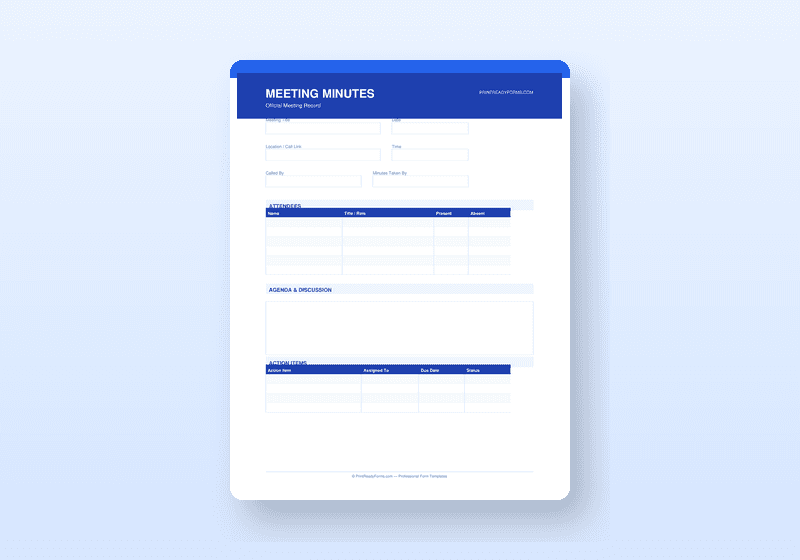
Key Takeaways
- Meeting minutes are a record of decisions made and actions assigned — not a transcript of the conversation.
- Every action item must have three elements: what needs to be done, who is responsible, and by when.
- Distribute minutes within 24 hours of the meeting while the content is still fresh.
- Board and formal governance meeting minutes are legal records and should be retained for a minimum of 7 years.
The majority of meeting minutes produced by small businesses are either not written at all, or written in a format so vague — "discussed the Q2 plan" — that they provide no useful record of what was actually decided or who is responsible for what.
Good meeting minutes are not a transcript of the conversation. They are a structured record of decisions made, actions assigned, and issues tabled for follow-up. They should be written quickly, distributed promptly, and clear enough that someone who was not in the room knows exactly what was agreed.
What meeting minutes must capture
Meeting identification
Every set of minutes starts with the basics: the name or type of meeting, the date, time, and location (or video call platform), the names of all attendees, and the name of the person chairing the meeting. Also note who is absent if they were expected to attend — this matters when decisions were made without input from people who had a stake in the outcome.
Approval of previous minutes
If this is a recurring meeting, note whether the minutes from the previous meeting were approved, and note any corrections. This creates a clean, confirmed record rather than a pile of drafts.
Agenda items discussed
Work through the agenda item by item. For each item, note the subject, a brief summary of the key points raised (not a full transcript — just the substance), and — most importantly — the decision or outcome.
If no decision was made on an item, that is itself worth noting: "Tabled pending receipt of Q2 financial data. Alex to provide data by April 25." This creates accountability for the follow-up and ensures the item does not drop off the agenda.
Action items — the most important section
Every action item must have three elements: what needs to be done, who is responsible for doing it, and when it must be completed by. Write every action item in this format and group them separately from the discussion notes.
"Marketing team to finalise the product launch campaign" is not an action item. "Sarah (Marketing) to deliver final campaign brief to the team by April 18" is. The difference is accountability. The first format means everyone thinks someone else is handling it. The second is unambiguous.
Decisions made
Separate the decisions from the discussions. A short decisions section — "The board approved the Q2 budget as presented. No further revisions required." — is more useful than burying the decision in three paragraphs of discussion notes.
Items deferred or tabled
Note any agenda items that were not addressed, deferred to a future meeting, or that require additional information before a decision can be made. Include the reason and the expected resolution date or next-steps owner.
Meeting Minutes & Agenda Templates
The template this guide walks through — ready to customize with your details in PDF, ZIP Bundle formats.
Format and length
Meeting minutes for a one-hour working meeting should typically be one to two pages. A well-run 30-minute team meeting might produce half a page of useful notes. Board meeting minutes for formal corporate governance may be longer, but even those should not document every word spoken — they document what was formally moved, seconded, voted on, and decided.
Use a consistent template for every meeting of the same type. Consistent formatting makes it faster to write minutes, easier to review past records, and simpler for attendees to find the decisions and actions they are looking for.
Timing and distribution
Minutes should be distributed within 24 hours of the meeting. The longer you wait, the less useful they are — people are already acting (or not acting) on their memory of the meeting, and any corrections or disputes about what was agreed become harder to resolve.
Distribute to all attendees and to relevant absent stakeholders. If any action items affect people who were not in the meeting, they should receive the minutes too — or at minimum, the relevant section. Do not make people chase follow-up by asking "what was decided about X?" — distribute the record and let people find their actions.
Meeting minutes as a governance tool
For businesses with boards, investors, or formal governance structures, meeting minutes are not administrative paperwork — they are a legal record. They document that decisions were made with proper authority, that required processes were followed, and that the business has a verifiable record of its governance actions. Maintain these records for as long as the decisions they document remain relevant — typically a minimum of seven years for formal board minutes.
Frequently Asked Questions
What should meeting minutes include?
Meeting minutes should include the meeting name, date, time, and location; a list of attendees and absentees; approval of previous minutes; a summary of each agenda item discussed and the decision or outcome; all action items with the assigned person and due date; any items deferred or tabled; and the name of the person who prepared the minutes.
How long should meeting minutes be?
Meeting minutes for a one-hour working meeting should be one to two pages. The goal is to capture decisions and actions, not to transcribe the conversation. If the minutes are longer than the meeting was, they are too detailed. If they do not clearly show what was decided and who is responsible for what, they are not detailed enough.
Who is responsible for taking meeting minutes?
The responsibility for taking minutes is typically assigned to an administrative coordinator, the meeting secretary, or a designated notetaker who rotates among team members. For board meetings, the corporate secretary is typically responsible. The person chairing the meeting should not take the minutes as they cannot effectively facilitate and document simultaneously.
Are meeting minutes legally binding?
Meeting minutes for formal governance meetings (board meetings, shareholder meetings, committee meetings) are legal records of decisions made with proper authority. They can be used as evidence in legal disputes about what was decided and by whom. For internal working meetings, minutes are not legally binding contracts but serve as the authoritative record of what was agreed.
Meeting Minutes & Agenda Templates
Professionally designed and formatted. Available in PDF, ZIP Bundle formats. 30-day money-back guarantee.
One-time purchase — use forever.
Related Guides

Founder, PrintReadyForms · 25 years writing technical documents, contracts, scopes of work, and procedures
Published
All guides on PrintReadyForms are written to help business owners, landlords, contractors, and HR professionals use professional documents effectively. This content is for informational purposes only and does not constitute legal or financial advice. Consult a qualified professional for advice specific to your situation.