What to Include on a Formal Invoice (Most Owners Miss)

Key Takeaways
- A formal invoice must include your business details, client information, unique invoice number, and payment terms.
- Late payment fees and payment method instructions reduce time-to-payment significantly.
- Missing contact information, invoice numbers, or due dates are the most common invoice mistakes.
- A consistent formal invoice template signals professionalism and accelerates approval by accounts payable teams.
Most small business owners and freelancers treat invoicing as an afterthought — fill in the amount, add the client name, send it off. But a poorly structured invoice creates real problems: late payments, disputes over what was agreed, and no legal protection if things go wrong.
A formal invoice is a structured business document. Every invoice you send is a record of a financial obligation. It should be complete, clear, and consistent every time you send one. Here is a complete breakdown of what to put on an invoice — and the mistakes that cost businesses money.
What is a formal invoice (and how it differs from a regular one)
A formal invoice is a structured, legally complete request for payment that meets the standards a business client's accounts payable team expects to receive. It is not a casual note that says "you owe me $500" — it is a formatted business document with specific required elements: a unique invoice number, your legal business identity, the client's legal entity name, itemized charges, payment terms, and applicable tax calculations.
The word "formal" matters because it signals three things to the receiving party:
- It is a legal record. A formal invoice can be entered into evidence in a contract dispute, used as a basis for filing a mechanic's lien (for contractors), submitted to a collections agency, or referenced in a tax audit. Informal payment requests cannot.
- It can be processed automatically. Most mid-size and large businesses route accounts payable through software that scans invoices for required fields. Missing a single one — invoice number, tax ID, PO reference — kicks the invoice into a manual review queue, which adds two to four weeks to payment.
- It establishes a paper trail your accountant can reconcile. Every formal invoice ties back to a customer record, a project, and a tax category. Informal requests live in email threads where they get lost at year-end.
If you have ever sent an invoice and received the response "please resend with our PO number on it" or "our system needs a unique invoice number" — you sent an informal payment request, not a formal invoice. The rest of this guide walks through every required element of a formal invoice, what each one prevents, and the mistakes that delay payment.
The essential elements of every formal invoice
1. Your business name, logo, and contact information
A formal invoice always opens with the identity of the sender. Include your full legal business name (or your personal name if you operate as a sole proprietor), your business mailing address, phone number, and email address. If you have a logo, put it at the top. This is not just about looking professional — clients need clear contact information to process your invoice through their accounts payable system, and some corporate clients will reject invoices that do not include a complete business address.
2. Your client's full name and billing address
Every formal invoice names the specific legal entity being billed — not just a contact person. For individual clients, use their full name. For business clients, use the registered legal entity name — not just the name of your contact person. If you ever need to take a non-paying client to small claims court or turn a debt over to a collection agency, the invoice needs to name the correct legal party. A common mistake is invoicing "John at ABC Corp" when the legal entity is "ABC Corporation LLC."
3. A unique, sequential invoice number
A formal invoice is identified by a unique, sequential invoice number. This makes record-keeping manageable, simplifies tax filing, and is legally required in many jurisdictions if you are registered for sales tax or VAT. Start a numbering system from day one and stick with it: INV-001, INV-002, and so on. For clients who generate multiple invoices, you can prefix with a client code: SMITH-001, SMITH-002. Never reuse invoice numbers, and never have gaps in your sequence — both are red flags in an audit.
4. Invoice date and payment due date
Two dates must appear on every formal invoice: the issue date and the payment due date. The invoice date starts the clock on payment terms. The due date tells the client exactly when payment is expected. Do not just write "Net 30" without specifying the actual calendar date. Write both: "Net 30 — due by March 15, 2026." Common payment terms are Net 15, Net 30, Net 45, or Due on Receipt. Choose based on your cash flow needs and industry norms — freelancers and small service providers typically use Net 15 or Net 30, while larger B2B suppliers may use Net 60 or Net 90.
5. Itemized list of services or products
The itemized table is the legal core of a formal invoice. Do not just write "consulting services — $2,000." Break it down. List each service or product as a separate line item with a description, quantity, unit price, and extended total. For example:
- Brand Strategy Workshop — 4 hours @ $250/hr — $1,000
- Competitive Analysis Report — 1 × $600 — $600
- Presentation Design — 3 hours @ $200/hr — $600
Itemized invoices are harder to dispute because the client can see exactly what they are paying for. They are easier for clients to approve through internal purchase order systems. And they give you a legal record of exactly what was delivered if the relationship turns contentious. A vague single-line invoice is a weak document — an itemized invoice is a strong one.
6. Subtotal, discounts, taxes, and total due
A formal invoice shows its math transparently — never just a bottom-line total. Start with the subtotal (sum of all line items before tax or discounts). If you are applying a discount, show it as a separate line. Then show tax — if you operate in a state that charges sales tax on services or products, calculate it as a separate line item. Finally, show the total due in a clear, prominent format. Hiding the total or making it hard to find increases client friction around payment.
Sales tax rules vary significantly by state and service type. Software services are taxable in some states and exempt in others. Consulting is treated differently in different jurisdictions. If you are unsure whether your services are taxable, consult an accountant or your state's Department of Revenue website.
7. Payment methods and exact payment instructions
A formal invoice eliminates payment friction by specifying exactly how to pay — do not make clients guess or email you to ask. For each payment method you accept, include complete instructions:
- ACH / bank transfer: Include your bank name, routing number, and account number
- Check: State who to make it out to and where to send it
- Credit card / online payment: Include your payment link (Stripe, PayPal, Square)
- Venmo / Zelle: Include your handle or registered phone number
The more friction you remove from the payment process, the faster you get paid. Clients who have to email you to ask how to pay will delay a week. Clients who see clear instructions pay the same day.
8. Late payment policy and fees
A late payment policy is only enforceable if it appears on the formal invoice itself. Common terms are 1.5% per month (18% annually) on overdue balances, or a flat late fee of $25–$50 after 30 days past due. State both the fee structure and when it applies: "A late fee of 1.5% per month will be applied to balances outstanding more than 30 days past the due date."
Even if you rarely collect late fees, having them on your invoice communicates that you are serious about payment terms. Clients who see a late fee clause tend to pay on time more consistently than clients who see no consequences for delay.
9. Purchase order reference (for corporate clients)
For corporate clients, a formal invoice must reference the matching purchase order. Many corporate accounts payable departments will not process an invoice without a matching PO number. Missing this causes invoices to sit in limbo for weeks while someone tracks down the approval chain.
10. Notes, thank you, and next steps
A formal invoice can include a brief notes section without losing professionalism. You can use it to reference the project or contract this invoice applies to, mention upcoming work or a renewal date, or simply include a short thank-you note. "Thank you for your business — it is a pleasure working with you" takes five seconds to write and builds goodwill that translates into faster payment and repeat business.
Professional Invoice Template Pack
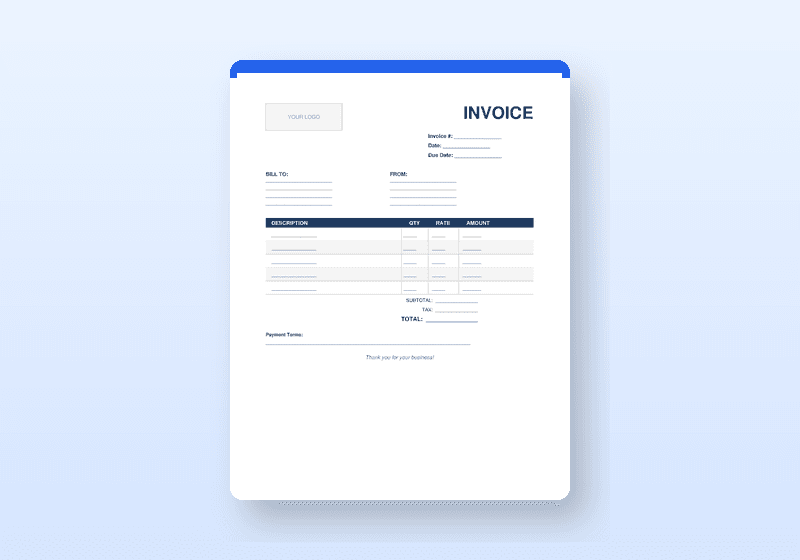
The template this guide walks through — ready to customize with your details in PDF, ZIP Bundle formats.
Common invoice mistakes that cost money
These are the errors we see most often on invoices from small businesses and freelancers — each one causes unnecessary friction and delayed payment:
- No invoice number. Makes record-keeping impossible and looks amateurish to accounts payable teams.
- No explicit due date. "Net 30" without a calendar date is ambiguous. State both.
- Missing payment instructions. If a client has to email you to ask how to pay, expect a one-week delay minimum.
- No late fee disclosure. You cannot enforce terms you never stated. Always include your late payment policy.
- Vague service descriptions. "Consulting — $3,000" creates disputes. Itemize everything.
- Wrong entity name. Billing the wrong legal entity complicates collection and tax records.
- Inconsistent formatting. Sending invoices that look different each time signals disorganization to clients and accountants.
Invoice formatting: what makes a professional invoice look professional
Content matters more than design, but design still matters. A professional invoice should have a clear visual hierarchy — your business information and logo at the top, client information below, a clearly labeled invoice table in the middle, and the total prominently displayed. Use consistent fonts and spacing. Keep it clean and scannable.
The invoice should fit comfortably on a single page for most transactions. If you have many line items, it is acceptable to run to two pages — but the total and payment information should be easy to find regardless.
How to make invoicing a system, not a task
Professional invoicing is not just about what is on one invoice — it is about consistency across every invoice you send. When every invoice you send looks the same, contains the same information, and uses the same format, three things happen:
- Clients process your invoices faster because they recognize the format and know where to find the information they need
- Your accountant or bookkeeper can reconcile your records more efficiently
- You have a clean, legally sound paper trail if a dispute ever arises
The fastest way to build a consistent invoicing system is to start with a template that has all the required fields already built in. Customize it once with your business information, and use it for every client. It takes less than 10 minutes to set up and saves hours over the course of a year.
Want a formal invoice template you can use today? Download our free formal invoice template — it includes every element described above, pre-formatted for instant use in PDF and Word.
A complete invoicing toolkit should include not just the invoice itself, but also a payment tracker to monitor outstanding balances, a payment receipt for confirming payments, a late payment reminder letter for overdue accounts, and a client information sheet to keep contact details organized. Together, these documents give you a professional, complete invoicing system rather than just a single form.
Frequently Asked Questions
What is a formal invoice?
A formal invoice is a structured legal document requesting payment for goods or services. It must include a unique invoice number, the sender's and recipient's full legal names and addresses, an itemised breakdown of charges, applicable taxes, the total due, payment terms, and accepted payment methods. Unlike an informal payment request, a formal invoice can be used as legal evidence, processed by automated accounts payable systems, and reconciled against tax records.
What is the difference between a formal invoice and a proforma invoice?
A formal invoice is a final demand for payment issued after goods or services have been delivered. A proforma invoice is a preliminary document — essentially a detailed quote — sent before delivery to confirm pricing, scope, and terms. The proforma is not a request for payment and is not entered into accounting records. The formal invoice is the legal document that triggers payment obligations.
Is a PDF invoice considered a formal invoice?
Yes — a PDF invoice is fully accepted as a formal invoice as long as it contains all required elements (invoice number, sender and recipient details, itemised charges, tax, total, payment terms). Most accounts payable software is specifically designed to ingest PDF invoices. The format does not affect legal standing; the content does.
Do I need a tax ID to issue a formal invoice?
No. Sole proprietors and freelancers can issue formal invoices using their personal name and address. Tax ID or VAT registration is required only if your business is registered as such — in which case the registration number must appear on every formal invoice you issue. If you are not registered, simply omit the field; the invoice remains formal and legally valid.
What should always be on a formal invoice?
Every formal invoice must include your business name and contact details, the client's name and address, a unique invoice number, the invoice date and payment due date, an itemised list of services or products, the total amount due, and your payment terms including accepted methods.
How do I number invoices professionally?
Use a sequential numbering system starting at 001 or a year-based prefix such as 2026-001. Never reuse invoice numbers. Consistent numbering makes it easy to track payments, reference invoices in communication, and maintain clean financial records.
Should I include payment terms on every invoice?
Yes. Payment terms belong on every formal invoice you send. State the due date clearly, your late fee policy, and the payment methods you accept. Clients with accounts payable departments require this information to process your invoice at all.
What is the difference between an invoice and a receipt?
An invoice is a request for payment sent before payment is made. A receipt confirms that payment has been received. Both should be part of your billing process — the invoice requests payment and the receipt confirms it.
Professional Invoice Template Pack
Professionally designed and formatted. Available in PDF, ZIP Bundle formats. 30-day money-back guarantee.
One-time purchase — use forever.
Related Guides

Founder, PrintReadyForms · 25 years writing technical documents, contracts, scopes of work, and procedures
Published · Updated May 22, 2026
All guides on PrintReadyForms are written to help business owners, landlords, contractors, and HR professionals use professional documents effectively. This content is for informational purposes only and does not constitute legal or financial advice. Consult a qualified professional for advice specific to your situation.