New Employee Onboarding Checklist: 30-Day Plan

Key Takeaways
- Structured onboarding in the first 30 days reduces early turnover by setting clear expectations from day one.
- Every new hire needs completed tax forms, signed offer letter, policy acknowledgements, and access credentials before starting work.
- The first week should cover role-specific training, team introductions, and an initial performance checkpoint.
- A documented onboarding checklist ensures consistency across hires and protects the business legally.
Studies consistently show that employees who go through a structured onboarding process are significantly more likely to still be with the company after 12 months — some research suggests up to 82% higher retention rates. Yet most small businesses treat onboarding as a paperwork event: get the I-9 signed, set up the computer, done. That is not onboarding. That is administration.
A real onboarding process sets someone up to succeed in their role, understand the organization, and feel like they made the right decision joining. It runs for at least 30 days — not 30 minutes. Here is what a complete onboarding plan looks like across every phase.
The four pillars of effective onboarding
Every strong onboarding program addresses four areas simultaneously:
- Compliance and paperwork — legal requirements completed correctly
- Systems and access — employee can actually do their job on day one
- Role clarity — employee knows what is expected and how success is measured
- Cultural integration — employee understands who they are working with and how things work here
Most small business onboarding covers the first two. The gaps in the third and fourth are what drive early turnover.
Before the first day: pre-boarding
Onboarding starts before the employee walks in the door. The week before a new hire starts, you should have completed the following:
Administrative pre-boarding
- Send an offer letter and collect the signed copy
- Initiate background check if required (allow 5–7 business days)
- Collect direct deposit information and set up payroll
- Enroll in benefits if applicable (health insurance enrollment windows are time-sensitive)
- Add to company communication platforms (email, Slack, Teams)
Workstation and systems setup
- Set up their workstation or ship their equipment (for remote employees, ship at least 3 days early)
- Create email account and verify it works
- Set up accounts for all software they will need on day one
- Prepare access credentials for each system
- Set up phone, voicemail, and any physical access cards or keys
The welcome package
Send a welcome email 2–3 days before start date that includes: first-day logistics (where to go, who to ask for, where to park), what to bring (ID documents for I-9), the agenda for the first day, and a brief warm note from their manager. Nothing makes a worse first impression than a new hire arriving to find their computer is not set up and no one was expecting them.
Day one: orientation
Day one sets the tone for everything that follows. The goal is to make the new employee feel expected, welcomed, and informed — not overwhelmed with information they cannot retain.
Morning: welcome and workspace
- Manager or HR greet them at the door (do not have them wander the office looking for someone)
- Tour of the workspace: their desk, bathrooms, kitchen, conference rooms, emergency exits
- Introductions to immediate team members
- Confirm their workstation is functional and they can log in to everything
Paperwork: legal compliance requirements
Day one paperwork is legally time-sensitive. The I-9 Employment Eligibility Verification must be completed by the end of the employee's first day of work. Required documents (Section 2) must be presented in person — remote onboarding has specific I-9 rules you need to follow carefully to remain compliant.
Standard day-one documents include:
- I-9 Employment Eligibility Verification (federal requirement)
- W-4 Federal Income Tax Withholding
- State tax withholding form (varies by state)
- Direct deposit authorization
- Employee handbook acknowledgment
- Non-disclosure agreement (if applicable)
- Emergency contact form
- Benefits enrollment forms (if not completed during pre-boarding)
Afternoon: role overview and team context
After paperwork, the manager should spend 60–90 minutes with the new hire covering: the team's purpose and how it fits within the organization, the new hire's specific role and responsibilities, what the first 30 days will look like, how their performance will be evaluated, and immediate priorities for the first week. This conversation should happen in person or on video — not via email or a document sent to read alone.
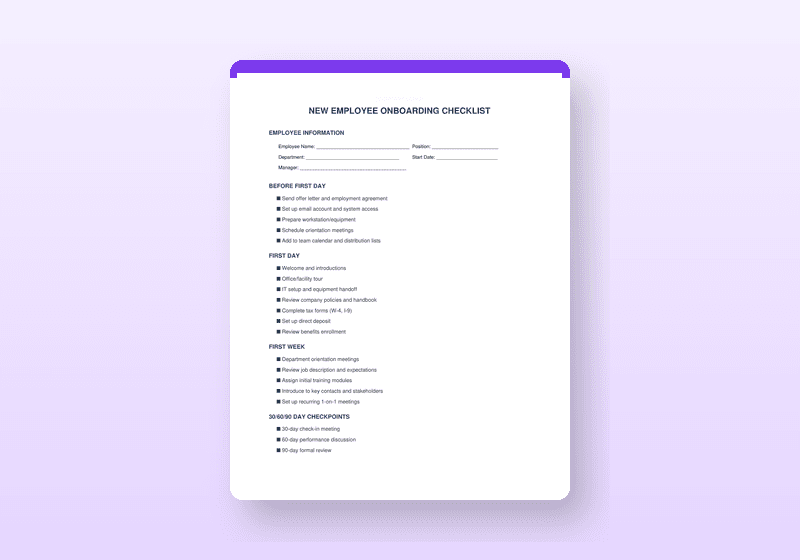
Employee Onboarding Package
The template this guide walks through — ready to customize with your details in PDF, ZIP Bundle formats.
The first week: building foundations
The first week should build the employee's understanding of their role, their tools, and their colleagues — not overwhelm them with every process and policy in the organization.
Systems training
Walk through every system the employee will use regularly: how to log time, submit expenses, access shared files, use communication tools, and complete any role-specific software. Do not send them a list of YouTube tutorials — walk through each system with them or assign a buddy to do so.
Shadow sessions
Schedule shadowing time with relevant colleagues. For a salesperson, this means sitting in on calls. For a customer service rep, this means watching how experienced team members handle tickets. Shadowing accelerates learning faster than any training document.
30/60/90 day goal-setting meeting
By end of week one, the manager should have a meeting to set clear, written 30/60/90 day goals. This conversation communicates what success looks like in concrete terms and gives the employee something to work toward rather than feeling like they are improvising. Write the goals down and give the employee a copy.
End-of-week check-in
Friday of week one, the manager should spend 15–20 minutes with the new hire: What went well? What is confusing? What do they need that they do not have? This check-in catches problems before they compound and signals that their experience matters.
Days 8–30: role immersion
The second through fourth weeks shift from orientation to actual work. The employee should be doing real tasks — not just observing — while receiving regular feedback and support.
Regular 1-on-1 meetings
Weekly 30-minute 1-on-1 meetings between the new employee and their manager are non-negotiable during the first 90 days. These meetings provide a structured forum for questions, feedback, and goal progress — preventing the "I did not want to bother anyone" dynamic that leads to employees quietly struggling.
Training completion checkpoints
Track formal training completion: safety training, compliance courses, software certifications, and any role-specific certifications. Use a checklist so nothing falls through the cracks and you have documentation of completion for compliance purposes.
Peer introductions beyond the immediate team
During weeks two and three, arrange 15-minute introductory meetings with stakeholders in other departments the employee will regularly interact with. This expands their network, helps them understand how the organization functions, and prevents the siloed feeling that makes new employees feel like outsiders.
30-day review
At the 30-day mark, conduct a structured check-in against the 30/60/90 goals set in week one. This is not a performance review — it is a progress conversation. Review what has been accomplished, what is on track, what needs adjustment, and what support the employee needs for the next 30 days. Document the conversation and keep a copy in the employee file.
What gets skipped and why it matters
The following onboarding elements are commonly omitted by small businesses — and they are the exact elements that drive early turnover:
- Written 30/60/90 goals. Without clear written expectations, employees spend their first 90 days guessing. They make decisions that do not align with how the manager wanted things done, leading to frustration on both sides.
- Regular manager check-ins. "Open door policy" is not a substitute for scheduled time. New employees rarely walk through open doors — they wait until things are bad enough that they are already considering leaving.
- Introductions to other departments. Employees who only know their immediate team feel like outsiders in the broader organization. They do not build the relationships that make work feel meaningful.
- Cultural context. How decisions get made, how conflict is handled, what the unspoken norms are — these are the things that take a year to learn without guidance and 30 minutes to teach intentionally.
Building a repeatable onboarding system
The best onboarding programs are consistent — every new hire goes through the same structured process regardless of who their manager is or when they start. Consistency requires documentation: a checklist that covers every step, templates for every communication, and a clear record of what was completed and when.
A complete onboarding package should include a pre-boarding checklist, a day-one orientation guide, a 30/60/90 day goal-setting template, a first-week schedule template, an employee handbook acknowledgment form, and a 30-day check-in template. When these documents are in place, any manager can run a thorough onboarding process without reinventing it from scratch every time someone new starts.
The time you invest in onboarding pays back in retention. The average cost of replacing an employee is 50–200% of their annual salary — training costs, lost productivity, recruiting fees, and management time. A structured 30-day onboarding process that increases retention by even 20% has an exceptional return on investment compared to the cost of building it.
Frequently Asked Questions
What should be included in an employee onboarding checklist?
An onboarding checklist should cover pre-start paperwork (tax forms, direct deposit, offer letter), day-one orientation (building access, equipment setup, team introductions), first-week training milestones, and 30/60/90-day review checkpoints. Every item should have a completion date and responsible person.
How long should employee onboarding take?
Effective onboarding runs for a minimum of 30 days and ideally 90 days. The first week covers essentials. The first month covers role-specific training and initial performance milestones. The 90-day mark is the standard end of a probationary period and a natural first formal review.
What paperwork is required for a new employee?
Required paperwork includes a completed Form I-9 (employment eligibility), Form W-4 (tax withholding), direct deposit authorisation, signed offer letter or employment contract, and acknowledgement of the employee handbook and any relevant policies.
What is the difference between onboarding and orientation?
Orientation is a one-time event that introduces the company, policies, and logistics. Onboarding is the full process of integrating a new employee into their role over their first weeks and months. Orientation is part of onboarding, but onboarding extends well beyond the first day.
Employee Onboarding Package
Professionally designed and formatted. Available in PDF, ZIP Bundle formats. 30-day money-back guarantee.
One-time purchase — use forever.
Related Guides

Founder, PrintReadyForms · 25 years writing technical documents, contracts, scopes of work, and procedures
Published · Updated April 1, 2026
All guides on PrintReadyForms are written to help business owners, landlords, contractors, and HR professionals use professional documents effectively. This content is for informational purposes only and does not constitute legal or financial advice. Consult a qualified professional for advice specific to your situation.