5 HR Documents Every Small Business Needs (And Most Don't Have)

Key Takeaways
- Every employee needs a signed offer letter or employment contract before their start date.
- An employee handbook documents your policies and protects you when those policies are enforced.
- Performance reviews create the documented record that supports disciplinary action and termination decisions.
- A termination letter confirms the employment ending in writing, protecting both parties.
Most small businesses operate for years without the basic HR documentation that protects them from employment disputes. Then something goes wrong — a termination, a complaint, a claim for unpaid wages — and suddenly the absence of a single document turns a manageable situation into an expensive one.
You do not need a dedicated HR function or an employment lawyer on retainer to protect your business. You need five documents. Here is what each one does and why it matters.
1. A written employment contract or offer letter
Every employee — full-time, part-time, casual — should have a signed written employment agreement before they begin work. At minimum, this document should specify: the job title and duties, the start date, whether the role is full-time or part-time, the wage or salary, pay frequency, probation period (if applicable), and notice requirements for resignation and termination.
A written employment agreement eliminates ambiguity about what was agreed. It is your primary protection against claims that you promised someone different compensation, a different role, or different terms than what you are now enforcing. An employee who has a signed offer letter specifying their notice period cannot later claim they were entitled to more.
2. An employee handbook or policy document
Policies enforced verbally are policies that can be contested. Your employee handbook documents the rules of the workplace — attendance expectations, code of conduct, performance standards, leave policies, social media policy, and the disciplinary process — so that every employee has access to the same information and cannot claim ignorance of standards.
Your handbook does not need to be long. A 10-page document that covers your core policies is more useful than a 50-page document nobody reads. Update it when policies change, and have every new hire sign an acknowledgement that they have received and read it.
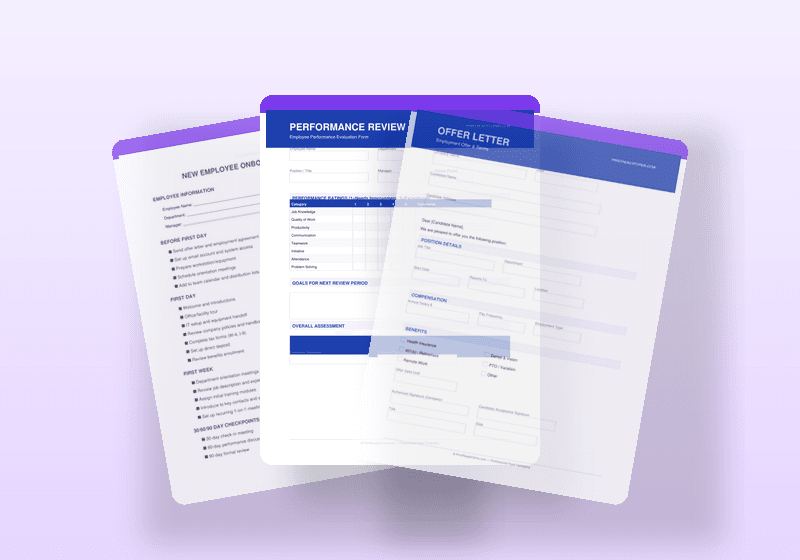
Complete HR & Employment Bundle
The template this guide walks through — ready to customize with your details in ZIP Bundle — 35 PDFs format.
3. A performance review form
Regular documented performance reviews protect you in two directions: they give you a written record of an employee's performance over time, and they create a documented trail of the feedback the employee received before any performance-related termination decision.
A termination without any prior performance documentation is legally vulnerable. A termination that follows three documented performance reviews — each showing the specific issues identified, the goals set, and whether they were met — is a defensible business decision. Conduct reviews at least annually. For employees in a probationary period, review them at the 30, 60, and 90-day marks.
4. A disciplinary or write-up form
When an employee's conduct or performance falls below your standards, you need a formal way to document it. A disciplinary form captures the specific incident, the policy or standard that was violated, the corrective action required, the consequence if the issue continues, and the employee's acknowledgement signature.
Consistent, documented progressive discipline — verbal warning, written warning, final written warning — creates the paper trail that makes a termination defensible. Without it, an employee who is terminated for repeated misconduct can claim they were never formally warned, and in the absence of documentation, that claim is difficult to disprove.
5. A termination letter
Every employment ending — whether initiated by the employer or the employee — should be confirmed in writing. A termination letter documents the effective date, the reason for termination (or confirmation that it is a resignation), final pay arrangements, return of company property, and continuation of any benefits.
For employer-initiated terminations, the termination letter is a critical document. It confirms that the employee was notified on a specific date, that the reason was clearly communicated, and that their entitlements were addressed. This documentation matters if a former employee files for unemployment, files a discrimination claim, or claims wrongful dismissal.
The cost of not having these documents
Employment disputes are expensive — in time, money, and management attention. The five documents above do not prevent every dispute. But they change the outcome when disputes occur. A business with thorough employment documentation is in a fundamentally stronger position than one that managed everything verbally and relied on memory. The paperwork takes an hour to set up. The exposure from not having it can cost months to resolve.
Frequently Asked Questions
What HR documents does a small business need?
At minimum, a small business needs: a signed offer letter or employment contract for every hire, an employee handbook covering core policies, a performance review form used at least annually, a disciplinary/write-up form for conduct and performance issues, and a termination letter template used at every employment ending.
Do small businesses need an employee handbook?
Yes. An employee handbook is not just for large companies. It documents your expectations, policies, and procedures in writing so that every employee has access to the same information. It protects you when you need to enforce a policy by establishing that the employee was informed of it. A basic handbook covering attendance, conduct, and leave is sufficient for a small business.
What should an offer letter include?
An offer letter should include the job title, start date, whether the role is full-time or part-time, the wage or salary and pay frequency, the length of the probation period, and the notice requirement for both resignation and termination. It should be signed by the employee before their start date.
Why does a small business need a termination letter?
A termination letter creates a documented record of when the employment ended, the reason, and what the employee's entitlements are. This documentation is critical if the former employee files for unemployment, files a discrimination claim, or disputes the termination. An employer with written documentation is in a far stronger position than one that relies on memory.
Complete HR & Employment Bundle
Professionally designed and formatted. Available in ZIP Bundle — 35 PDFs format. 30-day money-back guarantee.
One-time purchase — use forever.
Related Guides

Founder, PrintReadyForms · 25 years writing technical documents, contracts, scopes of work, and procedures
Published · Updated April 1, 2026
All guides on PrintReadyForms are written to help business owners, landlords, contractors, and HR professionals use professional documents effectively. This content is for informational purposes only and does not constitute legal or financial advice. Consult a qualified professional for advice specific to your situation.