Purchase Order vs. Invoice: What's the Difference and When to Use Each

Key Takeaways
- A purchase order (PO) is the buyer's written commitment to buy specific items at specific prices; an invoice is the seller's request for payment after delivery.
- The PO comes first and the invoice references it. Matching the two (plus the delivery record) is how accounts payable approves payment.
- Small businesses benefit from issuing POs for anything beyond petty purchases: they control spending, prevent surprise invoices, and create an audit trail.
- If a customer gives you a PO number, put it on the invoice exactly as written. A missing or wrong PO number is the most common reason invoices stall in AP.
Purchase orders and invoices get confused because they describe the same transaction — the same items, quantities, and prices — from opposite sides. The purchase order is the buyer saying "we want this, at this price, on these terms." The invoice is the seller saying "we delivered it; here is what you owe." One opens the transaction; the other closes it.
Understanding the difference matters more than it looks, because the two documents drive how money moves through a business. A seller who ignores purchase orders gets paid late. A buyer who never issues them loses control of spending. This guide covers what each document is, what belongs on it, how they fit together, and when a small business should start using purchase orders at all.
What a purchase order is
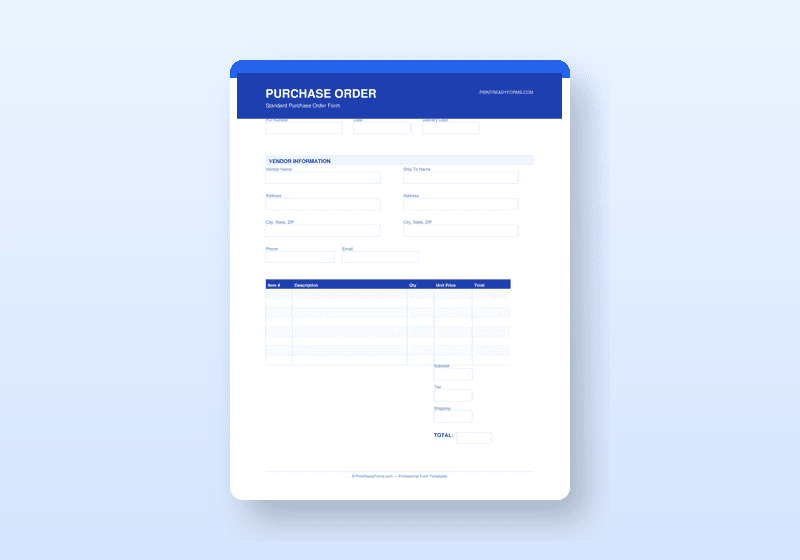
A purchase order is a document the buyer sends to the seller to formally request goods or services. It specifies exactly what is being ordered, in what quantity, at what price, delivered where and by when, under what payment terms. It carries a unique PO number assigned by the buyer.
Functionally, a PO does four things:
- Authorizes the spend inside the buyer's organization. Someone with authority approved this purchase before it happened.
- Communicates the order precisely to the seller, reducing "that's not what we asked for" problems.
- Creates a commitment that, once the seller accepts it, generally has contractual force.
- Gives accounts payable something to match the invoice against when it arrives.
A complete purchase order includes: buyer's business name and billing address; seller's name; PO number and date; ship-to address and requested delivery date; line items with description, part or SKU number, quantity, unit price, and line total; subtotal, tax, shipping, and total; payment terms (net 30, 2/10 net 30, due on receipt); any special instructions; and the name of the person authorizing the order.
What an invoice is
An invoice is a document the seller sends to the buyer after delivering goods or performing services, requesting payment. It itemizes what was delivered, states the amount due and the due date, and tells the buyer how to pay. It carries a unique invoice number assigned by the seller.
A complete invoice includes: seller's business name, address, and contact; buyer's name and billing address; invoice number and invoice date; the buyer's PO number, if one was issued; description of goods or services with quantities and unit prices; subtotal, tax, discounts, and total due; payment due date and terms; accepted payment methods and remittance details; and any late-payment terms. We cover this in detail in what to include on a formal invoice.
The key differences at a glance
| Aspect | Purchase order | Invoice |
|---|---|---|
| Issued by | Buyer | Seller |
| When | Before goods ship or work starts | After delivery or completion (or at agreed milestones) |
| Purpose | Authorize and specify a purchase | Request payment for what was delivered |
| Numbered by | Buyer (PO number) | Seller (invoice number); references the PO number |
| Accounting effect | Creates a commitment/encumbrance; not yet a liability | Creates accounts payable for the buyer and accounts receivable for the seller |
| Legal character | Offer to buy; contract once accepted | Demand for payment under the existing agreement |
Purchase Order Template Pack
The template this guide walks through — ready to customize with your details in PDF, ZIP Bundle formats.
How they work together: the three-way match
In any business with a formal accounts payable process, an invoice is not paid simply because it arrived. It is paid because it matches. The AP clerk or the software pulls up three documents:
- The purchase order — what was authorized, at what price.
- The receiving report or delivery confirmation — what actually arrived, in what quantity and condition.
- The invoice — what the seller is charging.
If quantities and prices agree across all three within tolerance, the invoice is approved for payment on its due date. If they do not — the invoice is for 110 units and the PO was for 100; the unit price is $14.50 and the PO said $14.00; there is no PO number at all — the invoice is parked in an exceptions queue until a human resolves it. That queue is where "net 30" becomes net 75.
For sellers, the practical lessons are blunt. Get the PO before you ship or start. Invoice exactly what the PO says, in the same units and descriptions. Put the PO number on the invoice, verbatim. If scope changed, get a revised PO or a written change approval before invoicing the difference. Every one of these is cheaper than chasing a late payment.
When a small business should start issuing purchase orders
Sole proprietors buying office supplies do not need POs. The moment any of the following is true, you probably do:
- More than one person can commit the business to a purchase.
- You buy inventory, materials, or subcontracted services in meaningful amounts.
- You have ever received an invoice and not known who ordered the item or whether the price was agreed.
- You want to know your committed spend — money you have promised but not yet been billed for — when you look at cash flow.
- Your accountant, lender, or a grant funder has asked how purchases are authorized.
A simple policy works: any purchase over a set threshold requires a PO approved by the owner or a named manager. The PO is sent to the supplier, and the invoice is matched against it before it is paid. Numbering is sequential, and the PO log is reviewed monthly. This is a one-page procedure and a template, not an ERP system.
Common mistakes
- Treating a quote as a PO. A quote is the seller's offer. A PO is the buyer's acceptance (or counter-offer). The PO should reference the quote number and match its prices.
- Issuing a PO after the invoice arrives, to make the paperwork look right. This defeats the control purpose entirely. If it happens often, the threshold is wrong or the approval process is too slow.
- Verbal POs. "Go ahead, I'll send a PO" followed by no PO. Sellers should hold shipment or at least hold the invoice until the PO number exists.
- Invoicing against a closed or exhausted PO. Blanket POs have a ceiling; once it is spent, further invoices bounce. Track the remaining balance.
- Mismatched descriptions. The PO says "Widget A, 12-pack" and the invoice says "WDG-A x 12 ea." Humans see the same thing; matching software may not.
Related documents worth knowing
Quote or estimate: seller's proposed price before the order. Order acknowledgment: seller's confirmation that it accepts the PO as written (or with noted changes). Packing slip / delivery note: accompanies the goods, lists what is in the shipment, no prices. Receiving report: buyer's internal record of what arrived. Credit note: seller's document reducing an invoice for returns, shortages, or errors. Statement of account: periodic summary of all invoices and payments between the parties, not itself a request for payment of any one item.
Used together, these form a clean paper trail from "we would like to buy" through "it arrived" to "it is paid." For the buyer, that trail is spending control. For the seller, it is the fastest route to being paid on time.
Frequently Asked Questions
Is a purchase order legally binding?
Once the seller accepts it (by acknowledgment or by shipping against it), a purchase order generally forms a contract for the goods or services described at the stated terms. Until acceptance, it is an offer. The exact treatment depends on the governing law and any master agreement between the parties.
Does a small business need purchase orders?
Not legally, but operationally they help as soon as more than one person can spend money or more than a few suppliers are involved. POs stop surprise invoices, make it clear who authorized a purchase, and give you something to match the invoice against. Many businesses set a threshold — say $250 — above which a PO is required.
Can an invoice be issued without a purchase order?
Yes, and in many small-business and consumer transactions it is. But if the customer's procurement policy requires a PO, an invoice without a valid PO number will usually be rejected or delayed regardless of whether the work was done. Ask for the PO before you start.
What is three-way matching?
Accounts payable compares three documents before paying: the purchase order (what was ordered and at what price), the receiving report or delivery note (what actually arrived), and the invoice (what the seller is charging). If all three agree, the invoice is approved. Discrepancies are held for review, which is why invoices that do not match the PO get paid late.
What is a PO number and where does it go on an invoice?
The PO number is the unique identifier the buyer assigned to their purchase order. It should appear prominently near the top of the invoice, usually next to the invoice number and date, exactly as the buyer wrote it, so their AP system can match the documents automatically.
Purchase Order Template Pack
Professionally designed and formatted. Available in PDF, ZIP Bundle formats. 30-day money-back guarantee.
One-time purchase — use forever.
Related Guides

Founder, PrintReadyForms · 25 years writing technical documents, contracts, scopes of work, and procedures
Published
All guides on PrintReadyForms are written to help business owners, landlords, contractors, and HR professionals use professional documents effectively. This content is for informational purposes only and does not constitute legal or financial advice. Consult a qualified professional for advice specific to your situation.