Contractor Proposal vs Scope of Work: What's the Difference and When You Need Each

In this guide
We cover everything you need to know about this topic — best practices, common mistakes to avoid, step-by-step guidance, and the right template to use. This guide takes about 5 min to read.
Contractors and clients use the terms "proposal" and "scope of work" interchangeably, but they are different documents that serve different purposes at different stages of a project. Using a proposal when you need a scope of work — or combining them poorly — creates gaps in your documentation that become expensive when something goes wrong.
What a contractor proposal is
A proposal is a sales document. It is produced before the contract is signed, before work begins, and before the client has made a final decision to engage you. Its purpose is to persuade: to demonstrate your understanding of the project, outline your approach, present your pricing, and give the client enough information to make a confident decision to hire you over a competitor.
A contractor proposal typically includes: an overview of the project as you understand it, your proposed approach and methodology, your qualifications and relevant experience, your pricing and what it includes, your timeline and key milestones, your payment terms, and a validity period for the pricing offered.
The proposal is not the contract. It is the document that leads to the contract. Once the client accepts your proposal, you move to a formal contract — which incorporates or references a scope of work as its technical backbone.
What a scope of work is
A scope of work is a technical document that defines precisely what will be done. Where the proposal is persuasive and commercial, the scope of work is precise and operational. Its purpose is to create an unambiguous record of what is included, what the deliverables are, and what the boundaries of the engagement are.
A scope of work typically includes: a detailed description of the work to be performed, material and product specifications, inclusions and exclusions, site conditions and assumptions the scope is based on, client responsibilities, deliverables and acceptance criteria, and the process for handling changes.
The scope of work becomes part of the contract. It is the document that both parties refer back to during the project when questions arise about what was agreed. When the client says "I thought you were doing X" and you say "X is not in scope," the scope of work is what resolves the dispute.
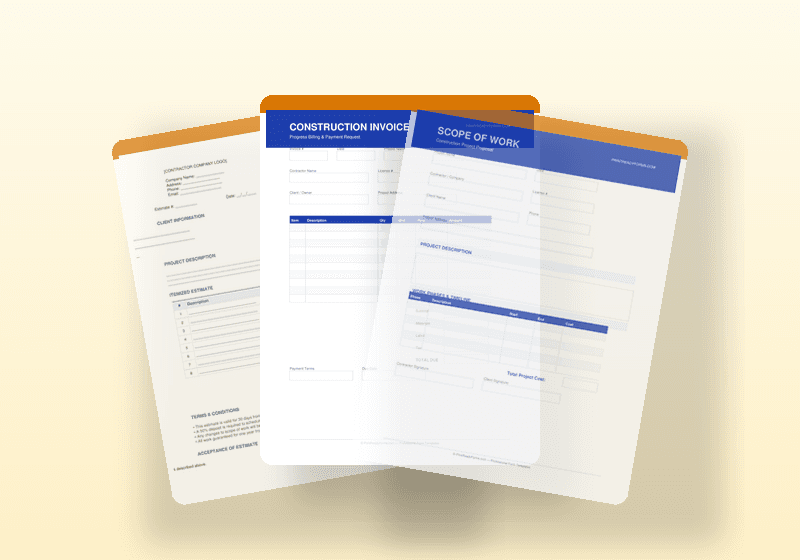
Complete Construction & Contractor Bundle
The template this guide walks through — ready to customize with your details in ZIP Bundle — 18 PDFs format.
When to use each
Use a proposal at the beginning of the sales process: when you are bidding on a project, when you want to demonstrate your understanding and approach before pricing, or when the client is comparing multiple contractors and needs to understand what differentiates your approach.
Use a scope of work once the client has decided to move forward and you are formalising the engagement: as an exhibit to your contract, as the technical definition that your estimate or contract price is based on, or as a standalone document for smaller engagements where a full proposal is not needed but the scope boundaries must be clear.
When you need both
For larger, more complex projects — commercial construction, multi-phase renovations, projects with multiple sub-trades — you typically need both. The proposal wins the job and sets the commercial terms. The scope of work, developed in more detail once the project parameters are confirmed, defines the technical execution.
In this case, the scope of work that forms part of the contract may be more detailed and technical than the scope summary in the proposal. The proposal scope says "complete bathroom renovation including tile, fixtures, and plumbing." The contract scope of work specifies every material, every method, every allowance amount, and every exclusion.
The common mistake: relying on the proposal as the scope
Many contractors never create a formal scope of work — they use the proposal as both the sales document and the scope definition. For simple, short-term engagements this may be adequate. For anything complex or multi-phase, it creates risk. Proposals are written to be persuasive, not technically precise. A proposal that describes scope in broad terms leaves room for the kind of interpretation that generates scope creep, disputes, and unpaid extras.
For any significant project, take the time to translate your proposal scope into a precise, specific scope of work before work begins. The extra documentation takes an hour or two. The protection it provides is worth considerably more than that when a scope dispute arises mid-project.
Complete Construction & Contractor Bundle
Professionally designed and formatted. Available in ZIP Bundle — 18 PDFs format. 30-day money-back guarantee.
One-time purchase — use forever.
Related Guides
How to Write a Contractor Estimate That Wins Jobs
Read guideConstruction & Contractor Forms5 Mistakes Contractors Make on Estimates (And How to Fix Them)
Read guideConstruction & Contractor FormsHow to Fill Out a Change Order (And Why Verbal Agreements Cost Contractors Money)
Read guide
Founder, PrintReadyForms · 25 years writing technical documents, contracts, scopes of work, and procedures
Published
All guides on PrintReadyForms are written to help business owners, landlords, contractors, and HR professionals use professional documents effectively. This content is for informational purposes only and does not constitute legal or financial advice. Consult a qualified professional for advice specific to your situation.