Subcontractor Agreement: What to Include When You Can't Afford a Lawyer

In this guide
We cover everything you need to know about this topic — best practices, common mistakes to avoid, step-by-step guidance, and the right template to use. This guide takes about 6 min to read.
Hiring a subcontractor without a written agreement is one of the most common and expensive mistakes general contractors make. When the sub does substandard work, misses a deadline, damages a client's property, or goes unpaid because there was no documented agreement on scope, the general contractor is exposed — both to the client and potentially to the sub themselves.
A written subcontractor agreement does not require a lawyer. It requires clarity about the terms of the working relationship. Here is what the agreement needs to cover.
Parties and project identification
Identify both parties clearly — the general contractor's business name and address, and the subcontractor's business name and address. Reference the specific project: the project name, address, and the prime contract or job number the subcontract relates to. A subcontractor agreement that does not specify which project it covers is legally ambiguous.
Scope of work
Write out the subcontractor's scope of work in specific detail. What exactly are they supplying and installing? What are the boundaries of their scope — where does their work begin and where does it end? What materials and equipment are they responsible for supplying versus what you are supplying?
Vague subcontractor scope descriptions lead to the same disputes as vague prime contract scope descriptions. If the scope says "framing" and the sub considers interior partition walls out of scope and you consider them included, you have a problem that a three-line scope description created. Be specific.
Schedule and milestones
Specify the start date, the expected completion date, and any intermediate milestones that are critical to the project schedule. Include what happens if the subcontractor falls behind — whether you can withhold payment, whether you can engage other contractors to complete the work at the sub's cost, and what the notice requirement is.
Also specify what happens if you cause delays on your end. If the site is not ready when the sub is scheduled to begin, what are your obligations? Many subcontractor disputes arise from site readiness — if you cannot control when the sub can access the site, your agreement should address this fairly.
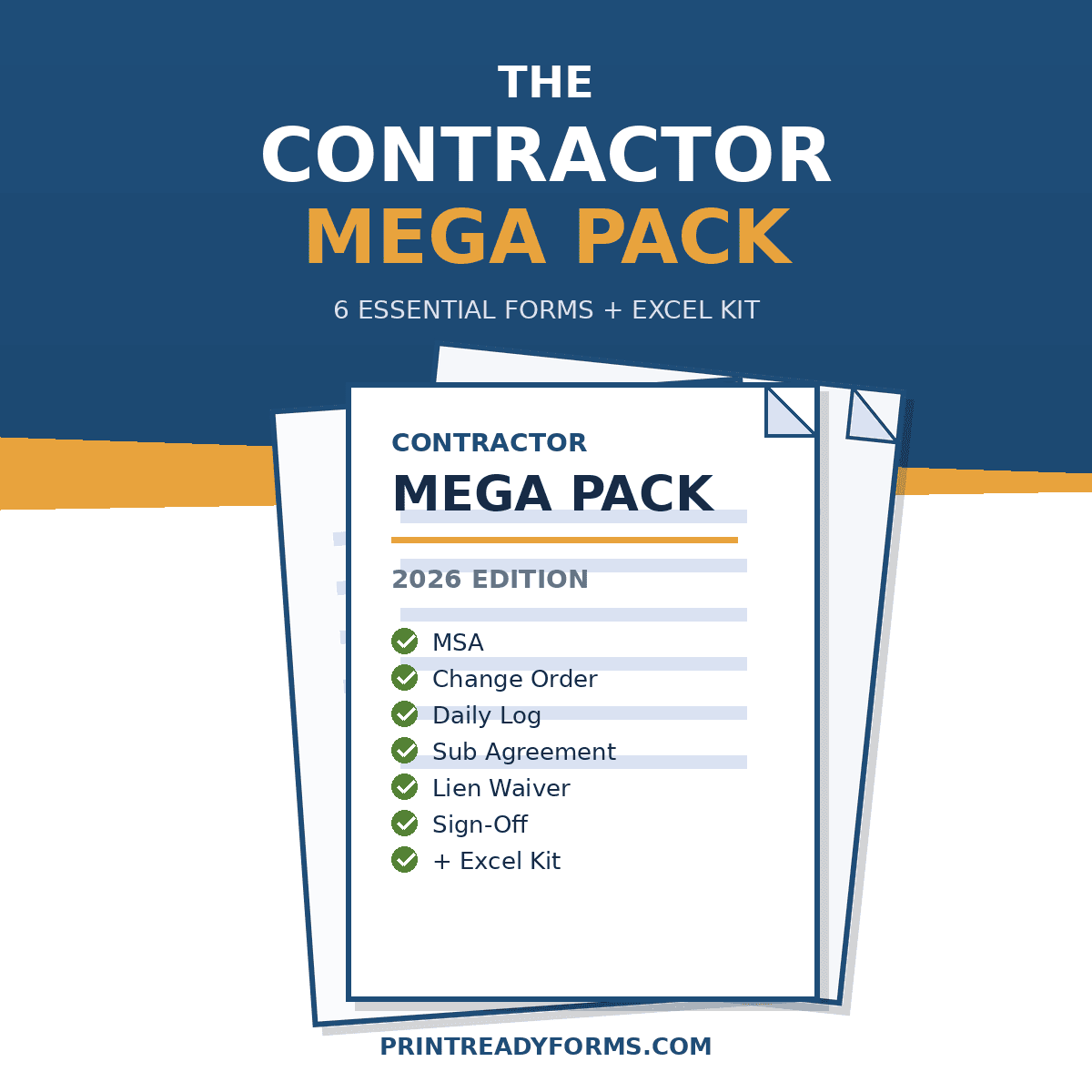
Contractor Project Control Kit + 6 Core Contracts
The template this guide walks through — ready to customize with your details in Excel .xlsx, Word .docx, PDF, ZIP Bundle formats.
Payment terms
State the total subcontract value, how it breaks down (lump sum, unit rates, cost plus), your payment schedule, and when invoices are due. Be explicit about your payment trigger — many general contractors make subcontractor payments contingent on receiving payment from the owner. In some states, "pay when paid" clauses have legal constraints, so understand your jurisdiction's rules before including this language.
Specify the process for change orders: that additional scope requires a written change order signed by both parties before the sub proceeds, and that the sub's price for changes will be submitted within a specified timeframe.
Insurance requirements
Require the subcontractor to carry and maintain general liability insurance and workers' compensation coverage at specified minimum limits. Name your business as an additional insured on their liability policy. Require them to provide a certificate of insurance before starting work.
This is not optional. If a subcontractor's employee is injured on site, or if the sub causes damage to the owner's property, and the sub has no insurance, you are exposed. Their insurance is your backstop.
Licence and compliance obligations
Require that the subcontractor hold all licences required by law to perform their scope in your state and jurisdiction. Confirm they are responsible for obtaining any permits required for their portion of work, unless you have explicitly agreed otherwise.
Include a clause requiring the sub to comply with all applicable laws, regulations, and safety standards, and confirming their status as an independent contractor — not an employee. The independent contractor classification affects your tax and insurance obligations. If the sub is misclassified, the legal and financial exposure falls on you.
Defect liability and warranty
Specify the subcontractor's obligation to correct defective work at their own cost. State the warranty period and what it covers. If your prime contract with the owner includes a defect liability period, your subcontract obligations to the sub should mirror them — you cannot pass on a warranty obligation to your client that your own subs will not back you on.
Dispute resolution
Include a clause specifying how disputes will be resolved — typically through negotiation first, then mediation, and then arbitration or litigation if unresolved. Also specify the governing law — which state's law applies — and the jurisdiction where disputes will be heard.
A properly documented subcontract does not prevent all disputes. But it establishes a clear framework for every issue that might arise — scope, payment, timeline, quality — so that when a dispute does occur, both parties know exactly where they stand.
Contractor Project Control Kit + 6 Core Contracts
Professionally designed and formatted. Available in Excel .xlsx, Word .docx, PDF, ZIP Bundle formats. 30-day money-back guarantee.
One-time purchase — use forever.
Related Guides
How to Write a Contractor Estimate That Wins Jobs
Read guideConstruction & Contractor Forms5 Mistakes Contractors Make on Estimates (And How to Fix Them)
Read guideConstruction & Contractor FormsHow to Fill Out a Change Order (And Why Verbal Agreements Cost Contractors Money)
Read guide
Founder, PrintReadyForms · 25 years writing technical documents, contracts, scopes of work, and procedures
Published · Updated April 1, 2026
All guides on PrintReadyForms are written to help business owners, landlords, contractors, and HR professionals use professional documents effectively. This content is for informational purposes only and does not constitute legal or financial advice. Consult a qualified professional for advice specific to your situation.