What Is a Scope of Work? How to Write One That Protects You on Every Project

Key Takeaways
- A scope of work defines precisely what will be done, what materials will be used, and what is excluded — it is the legal backbone of any project.
- The scope of work is different from an estimate (which prices the work) and a contract (which governs the relationship).
- An inclusions list and an exclusions list are equally important — both prevent "I thought that was included" disputes.
- Every change to the scope after the project begins must be documented in a signed change order.
A scope of work (SOW) is a formal document that defines exactly what work will be performed, by whom, under what conditions, and to what standard. It is used in construction, contracting, consulting, and any professional services engagement where there is potential for disagreement about what was agreed.
The scope of work is not the same as an estimate or a contract — though it is usually incorporated into both. The estimate prices the work. The contract governs the legal relationship. The scope of work defines the deliverables. All three need to be aligned, and the scope of work is the foundation on which the others are built.
Why a scope of work matters
Every project dispute that involves the phrase "I thought that was included" is a scope dispute. The scope was unclear, the parties interpreted it differently, and by the time the disagreement surfaces, the work is already in progress or — worse — complete.
A precise, well-written scope of work eliminates this category of dispute. When the scope document clearly defines what is included, what is excluded, what the deliverables are, and how changes will be handled, both parties are working from the same documented understanding. Disputes still occur, but they occur about facts — what was specified — rather than about recollections of a verbal conversation.
Complete Construction & Contractor Bundle
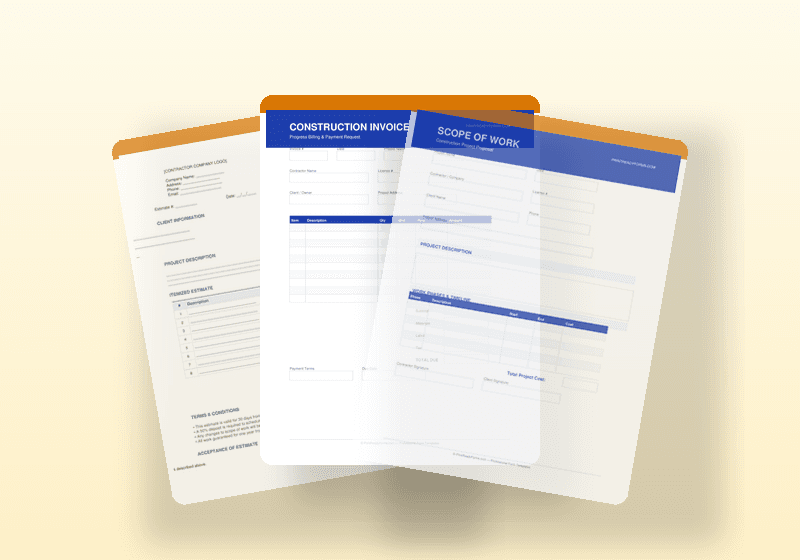
The template this guide walks through — ready to customize with your details in ZIP Bundle — 18 PDFs format.
What a scope of work should include
Project overview
A brief description of the project, its purpose, and the desired end state. This is the context for everything that follows. One paragraph is usually sufficient: what is being built, renovated, or delivered, and why.
Detailed work description
This is the core of the document. Describe the work to be performed in specific, unambiguous terms. For construction work, describe materials by specification (not just "tile" but "12x24 rectified porcelain tile, minimum 10mm thickness"), methods (not just "install tile" but "install using back-buttering method with appropriate thinset mortar"), and standards (to manufacturer's specifications and local building code).
For service engagements, describe the deliverables explicitly: what will be produced, what format it will be in, how many revisions are included, and what the completion criteria are. "A website" is not a deliverable. "A five-page responsive website built in Next.js with the specific pages listed in Exhibit A, live and functional in the production environment by the agreed completion date" is a deliverable.
Inclusions list
Explicitly list what is included in the scope. Do not assume the client understands that labour, materials, equipment, and disposal are all covered — state it. If specific allowances are included (client to select fixtures within a $2,000 plumbing fixture allowance), document those amounts.
Exclusions list
Equally important: list what is NOT included. If your scope covers new installation but not demolition of existing work, say so. If your electrical scope covers new outlets but not an upgraded panel, say so. If your consulting engagement excludes implementation, say so. Every ambiguity in this section is a potential dispute.
Site conditions and assumptions
Document the assumptions your scope is based on. If your flooring scope assumes a structurally sound, level subfloor, note that. If your software scope assumes the client will provide accurate data migration files, note that. When the actual conditions differ from the assumptions, the scope and pricing can be adjusted on documented grounds — not disputed in a he-said-she-said context.
Client responsibilities
What must the client do to enable the work? Access, decisions, approvals, payment of third-party fees, provision of materials — all of this should be documented. If the project is delayed because the client did not provide something they were responsible for, your documentation shows that the delay was not caused by you.
Deliverables and acceptance criteria
Define what "done" looks like. For construction, this is typically substantial completion as determined by inspection. For service work, it is specific deliverables in a defined format that meet the documented requirements. Ambiguous acceptance criteria lead to disputes at the finish line — when the work is 98% done and the client starts finding things that "aren't quite right."
Change order process
Include a brief section stating how changes to the scope will be handled. All changes require a written change order signed by both parties before work proceeds. This is one sentence, but it is one of the most important sentences in the document.
A good scope of work is the beginning of trust
Clients who receive a detailed, professionally written scope of work before agreeing to engage you are signalling that they are taking the engagement seriously. It sets the tone for the entire project relationship: that you are organised, that you communicate clearly, and that when issues arise, there is a documented foundation to resolve them from.
Frequently Asked Questions
What is a scope of work document?
A scope of work is a formal document that defines exactly what work will be performed, by whom, to what standard, with what materials, and under what conditions. It is used in construction, contracting, and professional services to create a clear written record of what was agreed before work begins. A well-written scope helps reduce confusion later about what was and was not included.
What is the difference between a scope of work and a contract?
A contract governs the legal relationship between the parties — payment terms, dispute resolution, liability, and termination rights. A scope of work defines the technical deliverables — what will be built or delivered, to what specification, and by what date. The scope of work is typically incorporated into the contract as an exhibit or attachment.
Who needs a scope of work?
Any contractor, consultant, or service provider engaging in a project with defined deliverables needs a scope of work. This includes general contractors, subcontractors, IT consultants, marketing agencies, landscapers, and any professional where the question "what exactly are you doing for this price?" needs a written answer.
What happens without a scope of work?
Without a documented scope of work, scope disputes are resolved by whoever tells the most convincing story. When a client says "I thought the painting included the garage" and you say "it did not," neither party has documentary evidence. The scope of work is that evidence. Without it, disputes are expensive, stressful, and often settled against the contractor.
Complete Construction & Contractor Bundle
Professionally designed and formatted. Available in ZIP Bundle — 18 PDFs format. 30-day money-back guarantee.
One-time purchase — use forever.
Related Guides
Contractor Proposal vs Scope of Work: What's the Difference and When You Need Each
Read guideConstruction & Contractor FormsHow to Fill Out a Change Order (And Why Verbal Agreements Cost Contractors Money)
Read guideConstruction & Contractor FormsHow to Write a Contractor Estimate That Wins Jobs
Read guide
Founder, PrintReadyForms · 25 years writing technical documents, contracts, scopes of work, and procedures
Published
All guides on PrintReadyForms are written to help business owners, landlords, contractors, and HR professionals use professional documents effectively. This content is for informational purposes only and does not constitute legal or financial advice. Consult a qualified professional for advice specific to your situation.