What the IRS Requires in a Mileage Log (and the Mistakes That Get Deductions Disallowed)

Key Takeaways
- The IRS requires a contemporaneous record of each business trip: date, destination, business purpose, and miles — plus total miles for the year.
- Commuting from home to a regular workplace is never deductible; trips between work locations, to clients, suppliers, and job sites generally are.
- Choose the standard mileage rate or actual expenses in the first year you use the vehicle for business; the choice limits your options later.
- Reconstructed logs built from memory at tax time are the most common reason mileage deductions are reduced or disallowed on examination.
Business mileage is a substantial deduction for contractors, real estate agents, consultants, delivery drivers, landlords, and anyone else whose work puts them in a vehicle. It is also one of the deductions the IRS examines most carefully, because it is easy to claim and hard to prove. The tax code requires "adequate records" for vehicle expenses, and the courts have been consistent about what that means: a log, kept at the time, showing each business trip.
This article covers what the record must contain, how to keep it without turning it into a second job, the difference between the standard mileage rate and actual expenses, and the errors that cause deductions to be disallowed. It is general information, not tax advice; rules have exceptions and your situation may differ, so confirm specifics with a tax professional or the current IRS publication on travel and car expenses.
What the record must contain
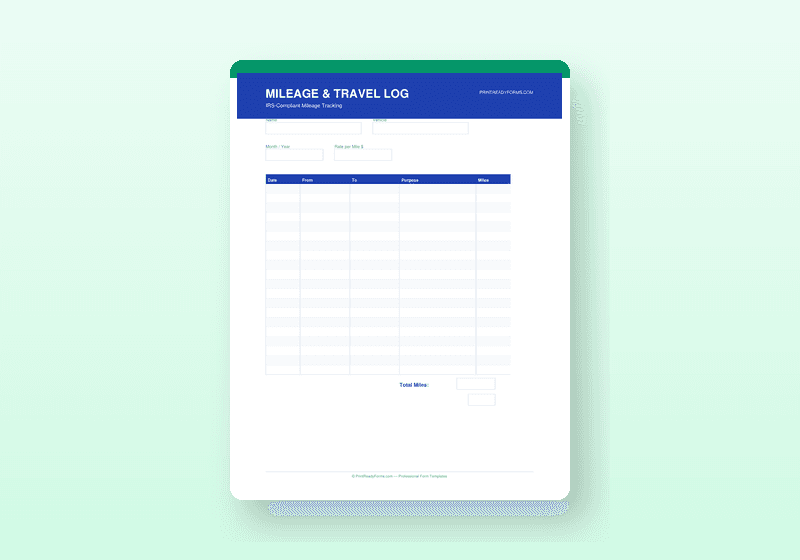
For each business use of the vehicle, the IRS expects you to be able to show:
- Date of the trip.
- Destination — where you went. A city or client name is the minimum; an address is better.
- Business purpose — why you went. "Client meeting — Henderson roof estimate," "pick up materials — ABC Supply," "showing — 412 Elm St." Vague entries like "work" or "errands" are the weakest part of most logs.
- Miles driven for the trip. Odometer start and end readings are the most defensible way to establish this.
In addition, you need the total miles the vehicle was driven during the year (business, commuting, and personal combined), which is why odometer readings on January 1 and December 31 — or the day you start and stop using the car for business — matter. The ratio of business miles to total miles is what drives the deduction under either method.
The record must be contemporaneous, meaning made at or near the time of the trip. A weekly entry made from a calendar is generally acceptable; a log reconstructed in March from memory is not, and examiners can tell the difference.
What counts as business mileage
Business miles are trips undertaken for your trade or business. Typical examples:
- Travel between two work locations — from your office to a client, from one job site to another.
- Trips to meet customers, prospects, suppliers, or your accountant.
- Trips to buy materials, supplies, or equipment for the business.
- Trips to the bank, post office, or government office on business.
- Landlords: travel to rental properties for inspections, repairs, showings, and meetings with contractors or tenants.
- Temporary work locations away from your regular workplace.
What does not count: commuting. The drive from home to your regular place of work and back is personal, no matter how far it is or how much business you discuss on the phone during it. The important exception is a qualifying home office that is your principal place of business: then trips from home to business destinations are business travel, because your home is the workplace. If you work from home but do not meet the home-office tests, the first and last trips of the day to a regular work location are still commuting.
Mixed trips are split. If you drive to a client, then to the grocery store, then home, the business leg is the mileage to the client (and from the client back toward the office or home, by the direct route); the detour to the store is personal.
Standard mileage rate vs. actual expenses
You can deduct vehicle costs one of two ways, and the log is required for both.
Standard mileage rate
Multiply business miles by the IRS rate for the year. The rate is set annually and published at IRS.gov; it is designed to cover fuel, maintenance, repairs, tires, insurance, registration, and depreciation. Business-related parking and tolls are deductible on top of it. This method is simple and, for most people with ordinary vehicles and high business mileage, generous.
Restrictions: to use the standard rate on a vehicle you own, you generally must choose it in the first year the vehicle is used for business. If you start with actual expenses and accelerated depreciation, you usually cannot switch to the standard rate for that vehicle later. There are also limits on using the standard rate for fleets of several vehicles at once.
Actual expenses
Total everything you spent to operate the vehicle — fuel, oil, repairs, tires, insurance, registration, lease payments or depreciation, loan interest (for the self-employed), washing — and deduct the business-use percentage of it. The percentage is business miles divided by total miles, from your log. This method takes more recordkeeping (every receipt) and can produce a larger deduction for expensive vehicles or those with high operating costs and lower mileage.
Either way, the mileage log is not optional. Under actual expenses it establishes the business-use percentage; under the standard rate it establishes the miles.
Mileage & Travel Expense Tracker
The template this guide walks through — ready to customize with your details in PDF, ZIP Bundle formats.
How to keep the log without hating it
Logs fail because they are tedious. Design for the minimum friction that still produces a compliant record.
- Pick one method and keep it in the car. A paper log in the door pocket, a spreadsheet on your phone, or a GPS tracking app. The best system is the one you will actually use on a Tuesday afternoon.
- Record the odometer on January 1 (photograph it) and again on December 31. Also when you buy or sell the vehicle or start using it for business.
- Enter trips daily or at least weekly, from your calendar and receipts if you did not do it in the moment. Note the purpose while you still remember it.
- Use consistent purpose descriptions that tie to something else in your records: a client name that appears on an invoice, a property address, a supplier on a receipt. Corroboration is what makes a log credible.
- Log parking and tolls with the trip; they are deductible separately under the standard rate.
- Total it monthly. A running monthly total catches gaps early and makes year-end trivial.
Apps that record trips automatically from GPS reduce the effort substantially, but you still need to classify each trip and record the purpose. An app log full of untagged trips is not much better than no log.
Mistakes that get deductions disallowed
- No log at all, or a round-number estimate ("about 15,000 business miles"). Without records, the deduction can be denied in full, regardless of how much driving you actually did.
- Reconstructed logs. Perfectly neat, identical handwriting, same pen, created the week before the audit. Examiners look for it.
- Vague purposes. "Business," "meeting," "errand." Each entry should say what the business was.
- Claiming commuting. The daily drive to the shop or office.
- Business percentage that does not fit the facts. Claiming 95% business use on the household's only vehicle invites questions.
- Missing total miles. Business miles without total miles means the examiner cannot verify the percentage.
- Switching methods improperly on the same vehicle.
- Double-dipping: taking the standard rate and also deducting fuel or repairs.
Employees and reimbursements
Under current federal law, employees generally cannot deduct unreimbursed business mileage on their personal returns. Employers can reimburse employees tax-free under an accountable plan if the employee substantiates the mileage with the same kind of log and returns any excess. If you have employees who drive for the business, require a log for every reimbursement request; it protects the deduction on the business side and keeps the reimbursement non-taxable on the employee's side.
Landlords specifically
Travel to and from rental properties for management, maintenance, and showings is generally a deductible rental expense, reported with the property's other expenses. The same log requirements apply. Keep the rental trips identifiable by property address, because the deduction is allocated to each property. Long-distance travel to a rental has additional rules; check them before claiming airfare or lodging.
What to keep with your return
The log itself (paper or export), the year-start and year-end odometer evidence, receipts for parking and tolls, and — if you use actual expenses — every vehicle receipt and the depreciation schedule. Keep them with that year's tax records for the full limitations period. A clean log that took five minutes a week will survive examination; the deduction it supports is usually worth far more than the time.
Frequently Asked Questions
What is the IRS standard mileage rate?
The IRS sets the rate each year (and occasionally adjusts it mid-year) and publishes it in a notice at IRS.gov. Because it changes, look up the figure for the specific tax year rather than relying on a number you remember. The rate covers fuel, maintenance, insurance, depreciation, and other operating costs; parking and tolls for business trips are deductible in addition to it.
Do I need odometer readings for every trip?
Not necessarily for every trip, but you need odometer readings at the start and end of the year (and when you start or stop using the vehicle for business) to establish total miles, and your per-trip records need to be accurate enough that business miles can be verified. Many people record odometer readings per trip because it removes any doubt.
Is driving from home to my first job site deductible?
If your home is your principal place of business (a qualifying home office), trips from home to job sites and clients are generally business miles. If you have a regular workplace elsewhere, the drive from home to that workplace is commuting and not deductible, though trips from that workplace to other business locations during the day are.
Can I use a GPS mileage app instead of a paper log?
Yes. The IRS does not prescribe the format, only the content and that it be kept at or near the time of the trip. An app that records date, start and end locations, miles, and lets you tag the business purpose satisfies the requirement. Keep the exported log with your tax records.
How long should I keep my mileage log?
At least as long as the return it supports can be examined — generally three years from the filing date, longer in some situations. If you use actual expenses and depreciate the vehicle, keep records for the life of the vehicle plus the limitations period.
Mileage & Travel Expense Tracker
Professionally designed and formatted. Available in PDF, ZIP Bundle formats. 30-day money-back guarantee.
One-time purchase — use forever.
Related Guides

Founder, PrintReadyForms · 25 years writing technical documents, contracts, scopes of work, and procedures
Published
All guides on PrintReadyForms are written to help business owners, landlords, contractors, and HR professionals use professional documents effectively. This content is for informational purposes only and does not constitute legal or financial advice. Consult a qualified professional for advice specific to your situation.